Templating
The counter is templated from installed cabinets, with overhangs, backsplash returns, sink and cooktop positions and seam locations marked on the template.
A countertop is templated, not guessed: measured from installed cabinets, cut to fit, and set so seams fall where they are least visible and sinks sit level. This page explains what countertop installation involves across stone, quartz and solid-surface materials in Los Angeles kitchens and bathrooms.
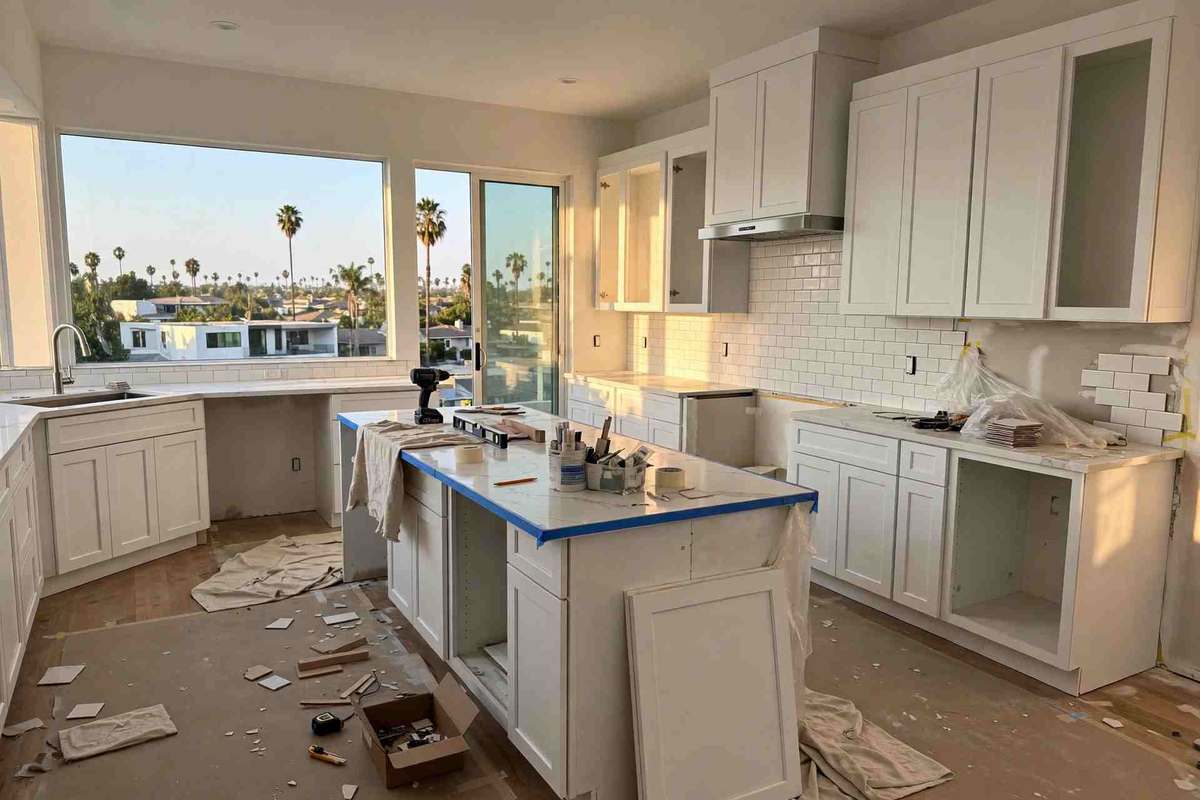
Countertop installation templates the counter from set, level cabinets, fabricates the slabs with sink and cooktop cutouts, edge profiles and seam placement, then installs, levels, seals and joins the pieces on site. The sequence matters: counters template only after cabinets are set and checked, because any cabinet error carries into stone, and sinks, faucets and appliances are fitted to the installed counter, not the other way round.
Counter cost varies by material, edge profile, cutouts, seam count and slab layout; pricing is set out in a written estimate after the site visit. The scope below is what a written estimate should itemise instead: templating, fabrication, installation, seams, sealing and fixture fitting.
Countertop scopes cover kitchens, bathrooms, laundry rooms and bars. The stages below cover a typical kitchen installation.
The counter is templated from installed cabinets, with overhangs, backsplash returns, sink and cooktop positions and seam locations marked on the template.
Slabs are selected and laid out so veining and pattern flow across seams, and offcuts are planned for smaller areas where the material allows.
Slabs are cut, edged, polished and cut out for sinks and cooktops, with seam edges prepared for a tight, level joint.
Counters are set, levelled and shimmed on cabinets, seams are joined and levelled, and the counter is checked flat across its full run.
Sinks are mounted, faucets and disposals are fitted, and cooktops are set into cutouts with clearances checked.
Stone is sealed where the material requires it, joints to walls and backsplashes are sealed, and the counter is walked against the written scope.
Cabinets are confirmed level, plumb and fixed, then the counter is templated with overhangs, cutouts and seams marked.
Slabs are cut, edged and cut out for sinks and cooktops, with veining and seam placement laid out from the template.
Counters are delivered, set and levelled on cabinets, with seams joined and checked flat.
Sinks, faucets, disposals and cooktops are fitted to the installed counter, with plumbing connections tested.
Stone is sealed where required, joints are sealed, and the finished counter is walked against the written scope.
Cabinets are confirmed level, plumb and fixed, then the counter is templated with overhangs, cutouts and seams marked.
Templates capture the exact cabinet run, including out-of-square walls, so fabrication matches the room rather than the drawing.
Slabs are cut and edged with profiles chosen for the kitchen style, from eased to ogee, with polished edges where the design calls for them.
Seams are levelled and joined with colour-matched adhesive, so the joint reads as a line, not a step.
Sealers are applied where the material requires them, with re-sealing guidance left for the household.
Installed counters are protected while backsplash tile, paint and appliances finish around them.
Sherman Oaks countertop scopes are often quartz or stone over semi-custom cabinets in a full kitchen remodel, with islands, waterfall edges and large slabs that make templating and seam placement the critical stages.
Encino countertop work in larger Valley kitchens often means long runs and islands where slab layout and veining flow across seams decide whether the counter reads as one surface or as joined pieces.
Where this work fits in Los Angeles: Sherman Oaks · Encino · Silver Lake · Studio City · Woodland Hills · Los Feliz.
Countertop failures show at seams, sinks and levels. These are the problems to scope for.
Ask a pro →Seams step when cabinets beneath them are unlevel or the joint is poorly prepared. Cabinets are checked before templating, and seams are levelled at installation.
A sink ordered without the cutout template, or a cabinet run that moved after templating, leaves a cutout that does not fit. Templating follows final cabinet positions.
Porous stone stains without sealing. Sealing is specified for the material, with re-sealing guidance for the household.
Thin stone around cutouts cracks under heat or load. Cutout reinforcement and clearances are part of fabrication, not an afterthought.
Radiant Renovations Co. holds a 4.8-star aggregate rating. No review count is published here, and no individual review quotations are shown on this page — full review text is shown on Google.
It depends on use, maintenance and budget: quartz for low maintenance and consistency, natural stone for unique veining with sealing, solid surface for seamless sinks. The household's cooking and cleaning habits narrow the choice.
Counters alone, in the same layout with no plumbing, gas, electrical or structural change, are generally cosmetic work. Moving sinks, gas or electrical with the counter scope changes the permit path.
Templating, fabrication and installation are separate stages, often across weeks, because fabrication follows templating from installed cabinets. The written scope should show each stage.
Seams are placed where least visible — at sinks, corners or appliance breaks — levelled and joined with colour-matched adhesive, and laid out during templating rather than decided on installation day.
Call (424) 337-6597 to talk through your countertops: material, templating, seams and what your cabinets will support. Radiant Renovations Co. is open 24 hours, 7 days a week.
Book Free Measure (424) 337-6597 →Call (424) 337-6597 to talk through your project. Radiant Renovations Co. is open 24 hours, 7 days a week. Tell us what you want to change and we will talk through what it takes, including the permit path for the scope.